
For a child travelling in an ambulance it can be a stressful time. The EVS seat not only keeps them safe, but lets them feel safe too: Comfortable, secure and protected.
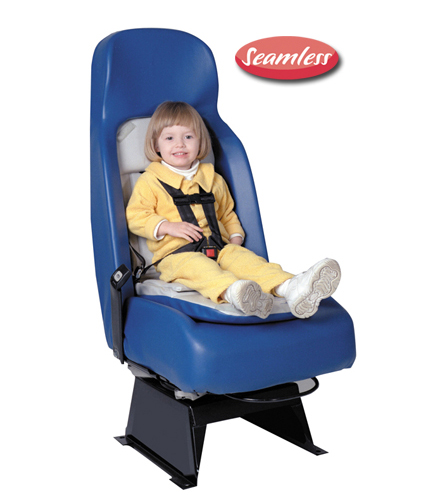
Safety Built in
A child who feels safe is a calmer passenger and an easier one to monitor, and in the EVS child seat the child sits upright, at a normal height, within the comfort of the padded seat.
The child restraint system is an integral part of the attendant seat. The insert folds down out of the seat in an instant, the five-point harness is already there, and the seat is ready to use in seconds — nothing to fetch, fit or store while under pressure.
When it is not needed, it simply folds away and the seat is instantly back to an ordinary attendant seat with a three-point belt.
Compliant
The EVS integrated child seat is a cost-effective solution to the NHS England Ambulance National Specification clause C109, which calls for converters to provide “a solution for the carriage of small children being transported as a passenger whose accompanying adult is the patient. Previously this capability was provided by all age seat belts. Due to a change in Regulation 16 preventing the fitting and use of all age adjustable seat belts in M1 vehicle types these can no longer be fitted.”
Proven Solution
EVS launched the first integrated child seat for ambulances in 1993. They have been in use in UK and European ambulances since 1995.
Type Approved to ECE R44
R44 remains the standard for built-in child restraints. That may surprise people who have seen that R44 is being withdrawn, so it is worth noting that the withdrawal only concerns portable child seats, the kind carried between cars and secured with a seat belt.
R44 has its own provisions. At paragraph 17.25, Contracting Parties “shall continue to accept type approvals of vehicle specific ‘built in’ or specific vehicle ‘built in’ child restraint systems”, and the provision carries no end date.
The VCA have confirmed the position directly: that a built-in child restraint does not fall within any approval category defined by ECE R129. This means that ECE R129 is not an applicable approval route for built-in child seats, and they continue to look for R44 approval and witnessed test reports.
We are testing to ECE R129 anyway
Although ECE R129 is not required for a built-in child restraint, we are running a full R129 approval programme, which includes witnessed dynamic testing across the range using mannequins of several different sizes, alongside other tests such as UV degradation and abrasion testing of the materials.
The main practical difference between the two regulations is how a child is matched to a seat. R44 uses a child’s weight; R129 uses their height — the same result, arrived at by a measure an adult can estimate more reliably in a hurry.
We are undertaking the testing despite it not being required by VCA, because we believe that having our seats tested to in excess of the regulations demonstrates that they remain the superior seats to specify.
Type Approval for child seats is not a one-off
Full Type Approval for a child seat is not a process of tests that are passed once and filed away. It requires ongoing Conformity of Production, which includes annual testing and independent assessment by a Type Approval Authority, confirming that the seats being produced today meet the same standards as the seats that were originally approved.
At EVS we have that carried out every year.